Top 3 Secrets of Crystalline Nano Silver
Crystalline nano silver is metallic silver manufactured as extremely small particles with an ordered crystal structure and dispersed in a liquid. The words crystalline, nano, and high purity describe physical characteristics of the material. They do not, by themselves, prove that a product is safer, more effective, or appropriate for treating a health condition.
If you are comparing silver products, focus on three questions: What is actually in the bottle? Has the particle size and structure been measured? Does the seller provide clear directions and responsible safety information?
This guide explains those questions using plain language, NutriNoche’s published particle-testing information, and current federal health guidance.
Table of Contents
- Quick answer
- What is crystalline nano silver?
- Fact 1: Nano describes particle size—not a health benefit
- Fact 2: Crystalline structure and purity describe the material
- Fact 3: Testing and transparent labels matter more than buzzwords
- Nano silver, colloidal silver, and ionic silver
- Important safety information
- What NutriNoche publishes about its silver
- Frequently asked questions
Quick Answer
The three most important facts about crystalline nano silver are:
- “Nano” refers to size. Nanomaterials generally have at least one dimension measuring approximately 1–100 nanometers. A smaller particle has a higher surface-area-to-volume ratio, but that fact alone does not establish a health benefit.
- “Crystalline” and “99.99% pure” describe the silver input. Crystalline refers to an ordered atomic structure, while 99.99% purity means the source silver contains a very small proportion of other material. Neither phrase is a substitute for finished-product testing.
- Documentation matters. Useful evidence includes particle imaging, size measurements, ingredient disclosure, concentration, lot identification, manufacturing controls, and clear directions and warnings.
What Is Crystalline Nano Silver?
Crystalline nano silver consists of metallic silver particles small enough to fall within the nanoscale and possessing an ordered crystal lattice. In a liquid silver product, those particles are dispersed throughout a water-based formula.
Each part of the name communicates something different:
- Silver identifies the element.
- Nano describes the particle-size range.
- Crystalline describes the particle’s internal atomic arrangement.
- Colloidal generally describes particles dispersed in a liquid.
These terms are related, but they are not interchangeable. A product can contain nanoscale silver particles without providing evidence of crystalline structure. A liquid described as colloidal silver may contain metallic particles, silver ions, or a combination, depending on its formulation and manufacturing process.
Fact 1: “Nano” Describes Particle Size—Not a Health Benefit

A nanometer is one-billionth of a meter. Nanomaterials are commonly discussed in the approximate range of 1–100 nanometers, although the exact definition can vary by technical or regulatory context.
For perspective:
- One micrometer equals 1,000 nanometers.
- A red blood cell is approximately 7–8 micrometers, or 7,000–8,000 nanometers, across.
- A 20-nanometer particle is therefore far smaller than a red blood cell.
That comparison helps explain scale, but it should not be used to claim that particles automatically enter cells, are “fully absorbed,” or are harmless. Particle behavior depends on more than diameter. Shape, surface chemistry, aggregation, concentration, surrounding liquid, exposure route, and dose can all matter.
Why Surface Area Gets So Much Attention
As particles become smaller, their surface area increases relative to their volume. That change can affect how particles disperse, interact with light, or behave in laboratory and material applications.
The key distinction is simple: higher relative surface area is a physical property, not proof of a clinical outcome. Responsible product education should keep those two ideas separate.
Fact 2: Crystalline Structure and Purity Describe the Material

In a crystalline material, atoms are arranged in an ordered, repeating pattern. Electron microscopy and related analytical methods can be used to examine particle shape, size, and crystalline characteristics.
“99.99% pure silver,” sometimes called four-nines silver, means the silver raw material is 99.99% silver by composition. High-purity input material can help limit unwanted metals or other contaminants and support more consistent manufacturing.
However, source-material purity does not tell you everything about the finished liquid. It does not independently establish:
- the particle-size distribution;
- how much silver is present in the bottle;
- the proportion of particles compared with dissolved ions;
- whether particles remain dispersed over time;
- the absence of every possible contaminant; or
- safety or effectiveness for a particular use.
This is why a purity percentage should be considered one quality detail rather than the entire quality story.
Fact 3: Testing and Transparent Labels Matter More Than Buzzwords

Terms such as “nano,” “ultra-pure,” and “crystalline” are meaningful only when they are supported by appropriate documentation. Before choosing a silver product, look for information that answers practical questions.
Particle Characterization
Has the company published microscopy or other analytical evidence showing particle size and structure? A single average is useful, but a particle-size distribution and an explanation of the testing method provide more context.
Finished-Product Concentration
Does the label clearly state the silver concentration and serving information? Concentration and particle diameter describe different characteristics; one cannot be inferred from the other.
Complete Ingredient Disclosure
Check the full ingredient list rather than relying on front-label phrases. Look for added salts, proteins, colorants, stabilizers, flavoring, or other ingredients when those details matter to you.
Lot and Quality Information
A quality-focused manufacturer should be able to identify production lots and explain its manufacturing and quality-control practices. Batch-specific testing is more informative than a general marketing claim that applies indefinitely to every bottle.
Responsible Claims
Be cautious when a seller claims silver can diagnose, prevent, treat, or cure a disease. The FDA has issued warning letters to companies whose silver-product claims caused their products to be treated as unapproved drugs under federal law.
Nano Silver, Colloidal Silver, and Ionic Silver
These descriptions often overlap, but they do not mean exactly the same thing.
Nano Silver
Nano silver refers to metallic silver particles in the nanoscale range. A proper nano-silver description should be supported by particle-size characterization.
Colloidal Silver
Colloidal silver is a broad term commonly used for silver dispersed in liquid. Depending on the product, the liquid may contain metallic particles, dissolved silver ions, or both.
Ionic Silver
Ionic silver refers to electrically charged silver atoms, written as Ag⁺, dissolved in the liquid. Ions are not the same as solid metallic nanoparticles.
This distinction matters because metallic particles and dissolved ions can behave differently. A clear label or supporting test should explain what form of silver is actually present instead of treating every silver liquid as identical.
Important Safety Information
Silver is not an essential dietary mineral and has no known nutritional function in the human body. According to the National Center for Complementary and Integrative Health, the FDA has warned that colloidal silver is not safe or effective for treating any disease or condition.
NCCIH also identifies several material risks:
- Silver can accumulate in body tissues and cause argyria, a usually permanent blue-gray discoloration of the skin.
- Colloidal silver may reduce the absorption of certain medicines, including some antibiotics and thyroxine.
- Evidence suggests possible kidney, liver, or nervous-system effects.
Do not use a silver product as a replacement for medical treatment. Speak with a qualified healthcare professional before use, especially if you take medication, are pregnant or nursing, have a medical condition, or are considering a product for a child.
What NutriNoche Publishes About Its Silver
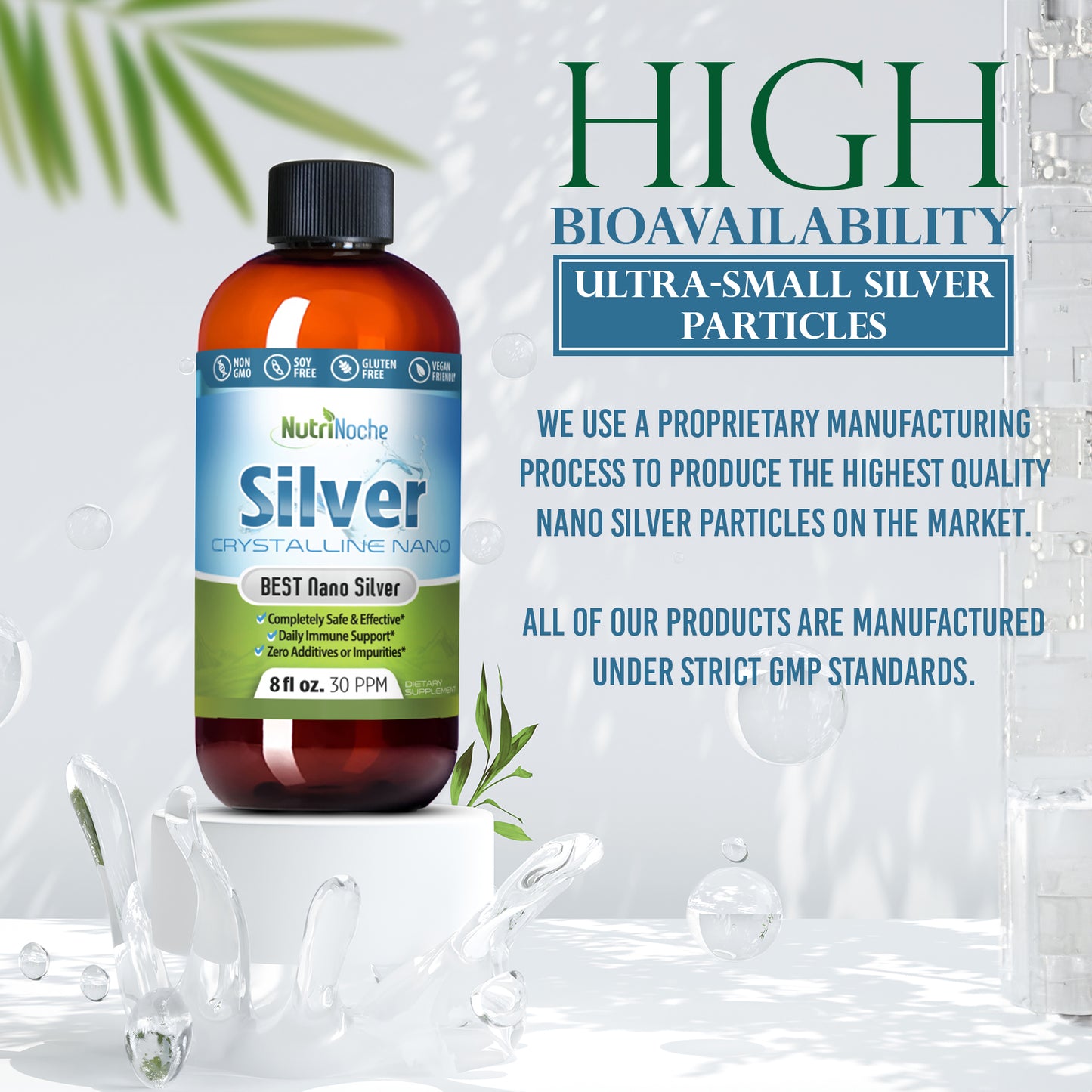
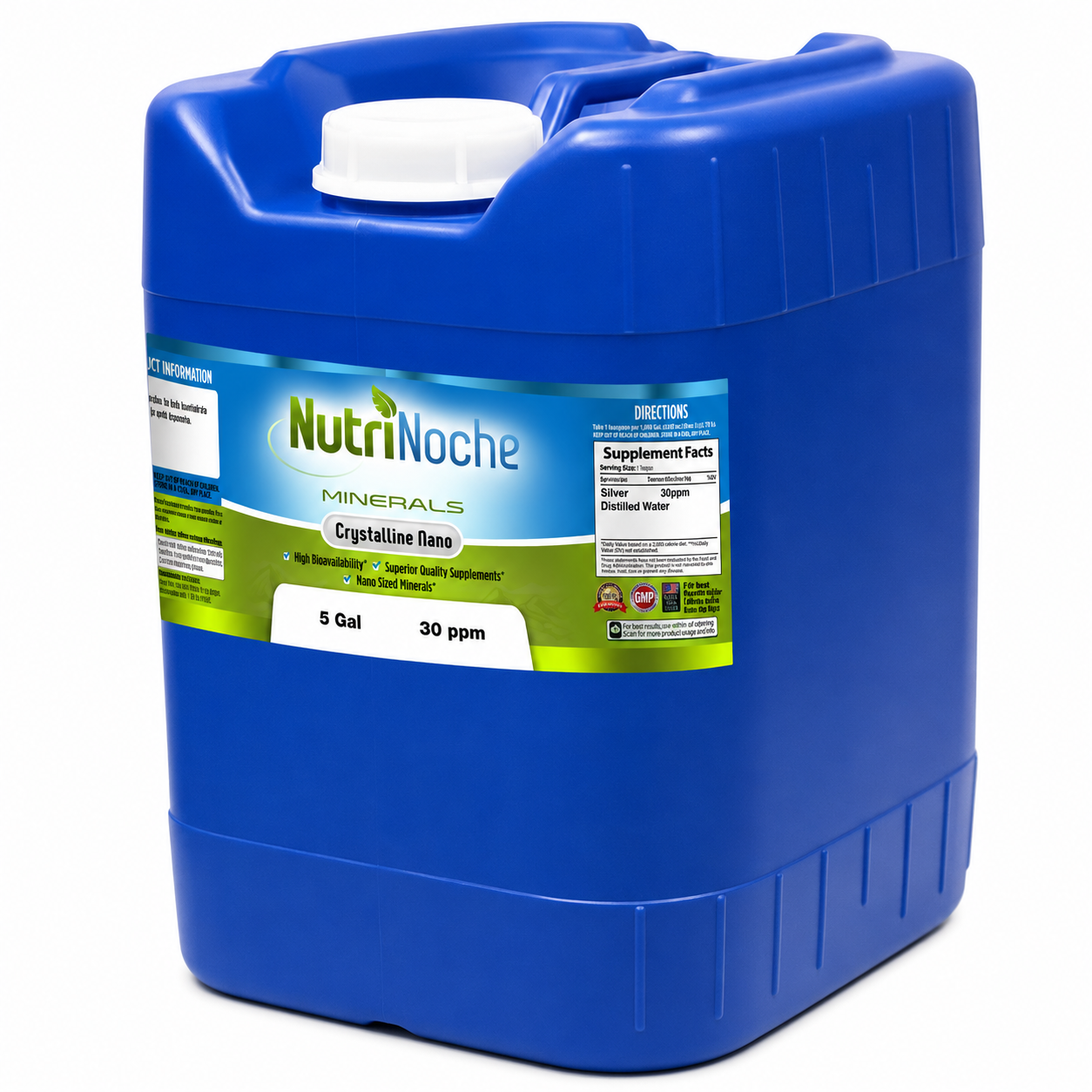
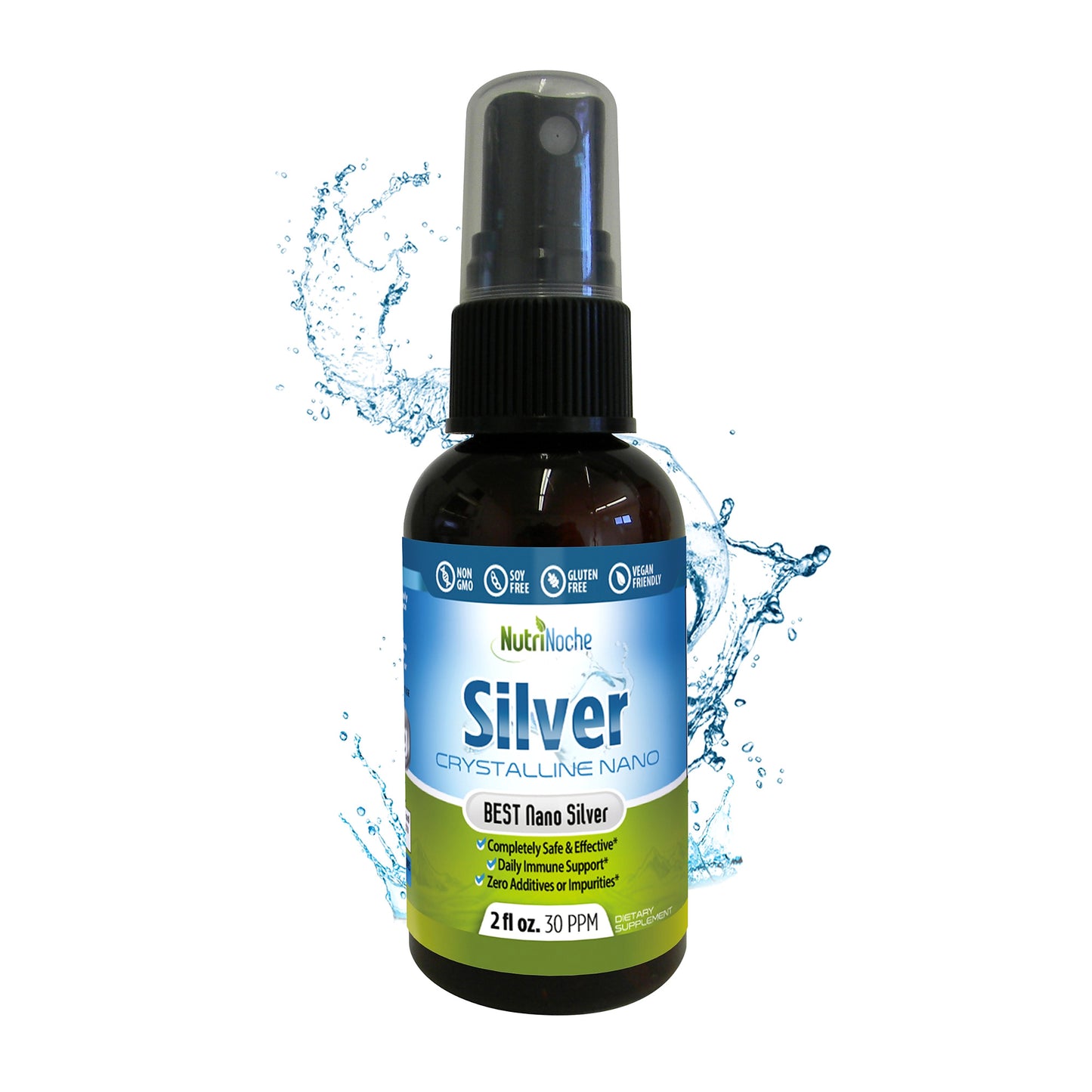
NutriNoche describes its product as a liquid containing 99.99% crystalline nano silver particles and water, without added salts or proteins. Review the current bottle label and NutriNoche Silver product page for the ingredients, concentration, directions, available sizes, and warnings that apply to the specific product you are considering.
NutriNoche also publishes a nano-particle testing page. According to that page, silver samples were examined using transmission electron microscopy and scanning transmission electron microscopy, commonly abbreviated TEM and STEM. NutriNoche reports that the tested silver particles were crystalline and had an average measured particle size of 19.84 nanometers.
That testing supports the company’s description of the examined sample’s particle size and structure. It should not be interpreted as evidence that the product prevents or treats disease, guarantees absorption, or eliminates the risks associated with silver exposure.
If you are evaluating NutriNoche or another brand, compare current labels and available testing rather than relying on a slogan. The bottle should tell you what you are buying; the documentation should help substantiate it.
Frequently Asked Questions
What does “crystalline nano silver” mean?
It describes metallic silver particles in the nanoscale range that have an ordered atomic structure. The phrase describes material characteristics and does not establish a medical benefit.
How small are NutriNoche’s reported silver particles?
NutriNoche’s published testing page reports an average particle size of 19.84 nanometers for the silver sample it describes. An average does not show the full range of particle sizes in a dispersion.
Does a smaller silver particle mean better absorption?
Particle size can affect material behavior, but size alone does not prove complete absorption, cellular uptake, easy excretion, safety, or a health benefit. Those claims require specific evidence.
What does 99.99% silver purity mean?
It means the silver input is described as 99.99% silver, leaving 0.01% for other material. It does not mean the finished liquid is 99.99% silver, nor does it replace finished-product testing.
Is nano silver the same as colloidal silver?
Not exactly. “Nano” specifies a particle-size characteristic. “Colloidal” broadly describes particles dispersed in liquid. Some colloidal silver products contain nanoscale metallic particles, while others may contain more dissolved silver ions.
Is ionic silver the same as a silver nanoparticle?
No. Ionic silver consists of dissolved charged silver atoms, while a nanoparticle is a small solid particle containing many silver atoms.
Does the color of a silver liquid prove its quality?
No. Color can be influenced by particle size, concentration, aggregation, lighting, and other formulation factors. It cannot, by itself, verify purity, concentration, particle size, or safety.
How should a silver liquid be stored?
Follow the storage directions on the current product label. In general, keep the container sealed and protect it from extreme temperatures and direct sunlight unless the manufacturer directs otherwise.
Can crystalline nano silver treat an illness?
Silver products should not be marketed or used to diagnose, treat, cure, or prevent disease. NCCIH states that the FDA has warned colloidal silver is not safe or effective for treating any disease or condition.
Where can I review NutriNoche’s product details?
Visit the NutriNoche Silver product page for current product specifications and the particle-testing page for the company’s published microscopy information.
The Bottom Line
The most useful “secrets” of crystalline nano silver are not secret at all. Nano describes size. Crystalline describes structure. Purity describes the silver input. None of those terms, standing alone, proves safety or a health outcome.
The strongest product comparison comes from transparent ingredients, clear concentration and directions, appropriate particle characterization, lot-level quality practices, and responsible claims. Read the current label, review the available documentation, and discuss safety questions with a qualified healthcare professional.
This article is provided for general education and is not medical advice. Silver is not an essential nutrient. This content and the products discussed are not intended to diagnose, treat, cure, or prevent any disease. Always follow the current product label and consult a qualified healthcare professional before use.